Wednesday, 26 August 2015

Understanding Storage Area Network (SAN) The Easy Way !!!!!


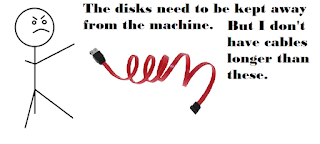
I've prepared a cartoon to make it easy to understand the Storage Area Network Concept. How do they work? Why they are used?...
This is thing according to my understanding, If anything is wrong or missing, or you have any questions please mention in comment.

Read more at http://kaustubhghanekar.blogspot.com/2012/03/understanding-storage-area-networks-san.html#pFzlj8glPFd6eufQ.99

Friday, 21 August 2015

Verifying Back-End Calls from Android Apps


Most Android apps have some sort of server-side back end, to persist and share data. Even the most basic game needs to remember its players’ high scores. When you’re building your back end, one problem you have to solve is how the back-end code knows what app it’s talking to and who the person using it is.
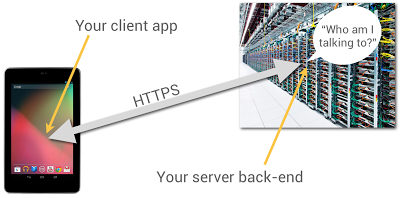
You probably have HTTP endpoints for communicating with your client apps, but how can the server-side code be sure who’s sending messages to it? After all, anyone can send HTTP POST requests from anywhere; could they impersonate your users if they could guess their identities?
It’s really user-unfriendly to ask people to type in usernames and passwords on mobile devices. In particular, if someone has installed your app and given it permission to use the Internet and know your identity, they shouldn’t be pestered any more.
It turns out that Google Play services, now available on every compatible device running Android release 2.2 or higher, offers a good solution to this problem, based on the use of Google Accounts.

Summary

Doing this is a multi-step process, which I’ll outline in full, but here’s the short version: You use the GoogleAuthUtil class, available through Google Play services, to retrieve a string called an “ID Token”. You send the token to your back end and your back end can use it to quickly and cheaply verify which app sent it and who was using the app.
This capability is built into Google facilities such as App Engine’s new Cloud Endpoints feature, which bakes app/back-end identity into a simple programming model.
Now let’s get to the details.

App Registration

You’re going to have to use the Google API Console quite a bit in this process. You’ll need to make a new project for this purpose; while you can give it a nice human-readable name and graphical branding, it turns out that those resources aren’t used in this particular scenario.
You can also authorize this project to access a large number of different Google APIs; but once again, you don’t need to in this scenario.
You should give serious thought to the people you authorize as members of the project, since these are important administrative roles.

Make Client IDs

You’ll need to make two different OAuth 2.0 “Client IDs” for your project. The first one is a “Client ID for Web applications”. Once again, you can ignore all the labeling and branding stuff, you’ll just need the Client-ID string, which will look something like 9414861317621.apps.googleusercontent.com.
Now you’ll need to make another Client ID for your Android app. To do this, you’ll need to provide two pieces of information: your app’s package name and cert signature. The package name is just the Java-style reverse-DNS, as given in the top-level “package” attribute in your AndroidManifest.xml, for example com.example.identity.
To get your app’s cert signature, use the following shell command:
$ keytool -exportcert -alias <your-key-name> -keystore <your-key-store-file> -v -list
Copy the octets labeled “SHA1”, paste them into the Developer Console field, and create your app’s Client ID. Once again, all you’ll really need from the readout is the Client-ID string.

In Your Android App

You’ll need to call the Google Play services GoogleAuthUtil class to get an ID token; the procedure is as described in Obtaining an Access Token. There’s one extra bit of magic: the value of the scope argument to the getToken(email, scope) method. It has to be the string audience:server:client_id:X, where X is the Client ID of for the Web app, as described above. If our Client ID were the example value given above, the value of the scope argument would be audience:server:client_id:9414861317621.apps.googleusercontent.com.

Magic Happens

Normally, when you ask for an OAuth token, the person using the device sees a challenge, asking them if it’s OK to use their identity to get at some resource or other. But in this case, the system looks at the server-side Client ID in your scope argument, notices that it’s in the same project as your Android app, and gives you the token without pestering the user; they’ve already agreed to a relationship with you, the developer who controls that project.

Send the Token

When you’re ready to start talking to your server back end, you need to send the token string to it. The best way to do this is in the body of an POST message; you could put it in a URL parameter, but they’re often logged. You absolutely must use an HTTPS connection, to keep any men-in-the-middle from peeking at your token.
There’s no particular reason for extra round-trips; if you’re sending a game high score to your back end, just stick the ID Token string in as an extra argument.

Use the Token

When your server receives the token from your Android app, it’s really important that you verify it. This requires two steps:
  1. Verify that it’s really signed by Google.
  2. Verify that it’s really meant for you.

Verify Signature

It turns out that this is signed using a Google public/private key pair, and Google publishes the public keys (which we change regularly) at www.googleapis.com/oauth2/v1/certs; go ahead and have a look.
You have to verify that the ID Token, which is actually a JSON Web Token, was signed with one of those certs. Fortunately, there are decent libraries around to do this; in this post, I’ll give pointers for Java, Ruby, and PHP.
The libraries can cache the Google certs and only refresh them when required, so the verification is (almost always) a fast static call.

Verify Token Fields

It turns out that the ID Token has a JSON payload, and most libraries that validate the signatures also give it to you as a hash or dictionary or whatever. Thus, you can retrieve named fields, such as aud and azp and email.
First, you have to look at the field named aud and verify that it’s identical to your Client ID, the string you included in the Android app’s scope argument. Seriously, do not omit this step; if you don't verify the ID Token, then any other developer can spoof requests to your service.
Optionally, you can look at the field named azp (stands for “authorized party”) and verify that it is identical to the Client ID of your Android app. By the way, you can have multiple different Android client apps, each with its own Client ID, in that top-level project.
Let’s assume you’ve done all three of these things. Then, you know that:
  1. The token was issued by Google.
  2. The token was sent to a device that was being operated by the person identified in the payload's email field.
You also have high confidence that:
  1. The token was obtained by the Android app identified by the Client ID in the payload’s azp field.
The Client ID only has “high confidence” because non-compatible or rooted Android devices may be able to tamper with that information. But they won't be able to fake the Google signature or the authentication of the device user to Google.

What’s Next?

That’s up to you. You know which person and app you’re talking to, it’s up to you what to do with that information.

Code Fragments

Here’s a Java class that implements an ID-Token checker using the Google Java libraries:
import java.io.IOException;
import java.security.GeneralSecurityException;
import com.google.api.client.googleapis.auth.oauth2.GoogleIdToken;
import com.google.api.client.googleapis.auth.oauth2.GoogleIdTokenVerifier;
import com.google.api.client.http.javanet.NetHttpTransport;
import com.google.api.client.json.JsonFactory;
import com.google.api.client.json.gson.GsonFactory;
public class Checker {

    private final List mClientIDs;
    private final String mAudience;
    private final GoogleIdTokenVerifier mVerifier;
    private final JsonFactory mJFactory;
    private String mProblem = "Verification failed. (Time-out?)";

    public Checker(String[] clientIDs, String audience) {
        mClientIDs = Arrays.asList(clientIDs);
        mAudience = audience;
        NetHttpTransport transport = new NetHttpTransport();
        mJFactory = new GsonFactory();
        mVerifier = new GoogleIdTokenVerifier(transport, mJFactory);
    }

    public GoogleIdToken.Payload check(String tokenString) {
        GoogleIdToken.Payload payload = null;
        try {
            GoogleIdToken token = GoogleIdToken.parse(mJFactory, tokenString);
            if (mVerifier.verify(token)) {
                GoogleIdToken.Payload tempPayload = token.getPayload();
                if (!tempPayload.getAudience().equals(mAudience))
                    mProblem = "Audience mismatch";
                else if (!mClientIDs.contains(tempPayload.getIssuee()))
                    mProblem = "Client ID mismatch";
                else
                    payload = tempPayload;
            }
        } catch (GeneralSecurityException e) {
            mProblem = "Security issue: " + e.getLocalizedMessage();
        } catch (IOException e) {
            mProblem = "Network problem: " + e.getLocalizedMessage();
        }
        return payload;
    }

    public String problem() {
        return mProblem;
    }
}
If you wanted to do this in Ruby, you’d want to install the google-id-token Ruby gem, and do something like this:
require 'google-id-token'
validator = GoogleIDToken::Validator.new
jwt = validator.check(token, required_audience, required_client_id)
if jwt
  email = jwt['email']
else
  report "Cannot validate: #{validator.problem}"
end

Wednesday, 19 August 2015

10 Upcoming Technology That May Change The World


We have seen great leaps in digital technology in past the past five years. Smartphones, cloud computing, multi-touch tablets, these are all innovations that revolutionized the way we live and work. However, believe it or not, we are just getting started. Technology will get even better. In the future, we could live like how people in science fiction movies did.
revolutionary product
(Image Source: YouTube)
Today’s post is about 10 upcoming, real-life products that is set to revolutionize the world as we know it. Get ready to control the desktop and slice Ninja fruits with your eyes. Get ready to print your own creative physical product. Get ready to dive into the virtual world, and interact with them. Come unfold the future with us.

1. Google Glass

Augmented Reality has already gotten into our life in the forms of simulated experiment and education app, but Google is taking it several steps higher with Google Glass. Theoretically, with Google Glass, you are able to view social media feeds, text, Google Maps, as well as navigate with GPS and take photos. You will also get the latest updates while you are on the ground.
google glass
(Image Source: YouTube)
It’s truly what we called vision, and it’s absolutely possible given the fact that the Google’s co-founder, Sergey Brin has demo’ed the glass with skydivers and creatives. Currently the device is only available to some developers with the price tag of $1500, but expect other tech companies trying it out and building an affordable consumer version.

2. Form 1

Just as the term suggests, 3D printing is the technology that could forge your digital design into a solid real-life product. It’s nothing new for the advanced mechanical industry, but a personal 3D printer is definitely a revolutionary idea.
Everybody can create their own physical product based on their custom design, and no approval needed from any giant manufacturer! Even the James Bond’s Aston Martin which was crashed in the movie was a 3D printed product!
form 1
(Image Source: Kickstarter)
Form 1 is one such personal 3D printer which can be yours at just $2799. It may sound like a high price but to have the luxury of getting producing your own prototypes, that’s a reaonable price.
Imagine a future where every individual professional has the capability to mass produce their own creative physical products without limitation. This is the future where personal productivity and creativity are maximized.

3. Oculus Rift

Virtual Reality gaming is here in the form of Oculus Rift. This history-defining 3D headset lets you mentally feel that you are actually inside a video game. In the Rift’s virtual world, you could turn your head around with ultra-low latency to view the world in high resolution display.
There are premium products in the market that can do the same, but Rift wants you to enjoy the experience at only $300, and the package even comes as a development kit. This is the beginning of the revolution for next-generation gaming.
oculus rift
(Image Source: Kickstarter)
The timing is perfect as the world is currently bombarded with the virtual reality topic that could also be attributed to Sword Art Online, the anime series featuring the characters playing games in an entirely virtual world. While we’re getting there, it could take a few more years to reach that level of realism. Oculus Rift is our first step.

4. Leap Motion

Multi-touch desktop is a (miserably) failed product due to the fact that hands could get very tired with prolonged use, but Leap Motion wants to challenge this dark area again with a more advanced idea. It lets you control the desktop with fingers, but without touching the screen.
leap motion
(Image Source: Leap Motion)
It’s not your typical motion sensor, as Leap Motion allows you to scroll the web page, zoom in the map and photos, sign documentss and even play a first person shooter game with only hand and finger movements. The smooth reaction is the most crucial key point here. More importantly, you can own this future with just $70, a price of a premium PS3 game title!
If this device could completely work with Oculus Rift to simulate a real-time gaming experience, gaming is going to get a major make-over.

5. Eye Tribe

Eye tracking has been actively discussed by technology enthusiasts throughout these years, but it’s really challenging to implement. But Eye Tribe actually did this. They successfully created the technology to allow you to control your tablet, play flight simulator, and even slice fruits in Fruit Ninja only with your eye movements.
eye tribe
(Image Source: Eye Tribe)
It’s basically taking the common eye-tracking technology and combining it with a front-facing camera plus some serious computer-vision algorithm, and voila, fruit slicing done with the eyes! A live demo was done in LeWeb this year and we may actually be able to see it in in action in mobile devices in 2013.
Currently the company is still seeking partnership to bring this sci-fi tech into the consumer market but you and I know that this product is simply too awesome to fail.

6. SmartThings

The current problem that most devices have is that they function as a standalone being, and it require effort for tech competitors to actually partner with each other and build products that can truly connect with each other. SmartThings is here to make your every device, digital or non-digital, connect together and benefit you.
smartthings
(Image Source: Kickstarter)
With SmartThings you can get your smoke alarms, humidity, pressure and vibration sensors to detect changes in your house and alert you through your smartphone! Imagine the possibilities with this.
You could track who’s been inside your house, turn on the lights while you’re entering a room, shut windows and doors when you leave the house, all with the help of something that only costs $500! Feel like a tech lord in your castle with this marvel.

7. Firefox OS

iOS and Android are great, but they each have their own rules and policies that certainly inhibit the creative efforts of developers. Mozilla has since decided to build a new mobile operating system from scratch, one that will focus on true openness, freedom and user choice. It’s Firefox OS.
Firefox OS is built on Gonk, Gecko and Gaia software layers – for the rest of us, it means it is built on open source, and it carries web technologies such as HTML5 and CSS3.
firefox os
(Image Source: Mozilla)
Developers can create and debut web apps without the blockade of requirements set by app stores, and users could even customize the OS based on their needs. Currently the OS has made its debut on Android-compatible phones, and the impression so far, is great.
You can use the OS to do essential tasks you do on iOS or Android: calling friends, browsing web, taking photos, playing games, they are all possible on Firefox OS, set to rock the smartphone market.

8. Project Fiona

Meet the first generation of the gaming tablet. Razer’s Project Fiona is a serious gaming tablet built for hardcore gaming. Once it’s out, it will be the frontier for the future tablets, as tech companies might want to build their own tablets, dedicated towards gaming, but for now Fiona is the only possible one that will debut in 2013.
project fiona
(Image Source: Razer™)
This beast features next generation Intel® Core i7 processor geared to render all your favorite PC games, all at the palm of your hands. Crowned as the best gaming accessories manufacturer, Razer clearly knows how to build user experience straight into the tablet, and that means 3-axis gyro, magnetometer, accelerometer and full-screen user interface supporting multi-touch. My body and soul are ready.

9. Parallella

Parallella is going to change the way that computers are made, and Adapteva offers you chance to join in on this revolution. Simply put, it’s a supercomputer for everyone. Basically, an energy-efficient computer built for processing complex software simultaneously and effectively. Real-time object tracking, holographic heads-up display, speech recognition will become even stronger and smarter with Parallella.
parallella
(Image Source: YouTube)
The project has been successfully funded so far, with an estimated delivery date of February 2013. For a mini supercomputer, the price seems really promising since it’s magically $99! It’s not recommended for the non-programmer and non-Linux user, but the kit is loaded with development software to create your personal projects.
I never thought the future of computing could be kick-started with just $99, which is made possible using crowdfunding platforms.

10. Google Driverless Car

I could still remember the day I watch the iRobot as a teen, and being skeptical about my brother’s statement that one day, the driverless car will become reality. And it’s now a reality, made possible by… a search engine company, Google.
While the data source is still a secret recipe, the Google driverless car is powered by artificial intelligence that utilizes the input from the video cameras inside the car, a sensor on the vehicle’s top, and some radar and position sensors attached to different positions of the car. Sounds like a lot of effort to mimic the human intelligence in a car, but so far the system has successfully driven 1609 kilometres without human commands!
google driverless car
(Image Source: Wikipedia)
“You can count on one hand the number of years it will take before ordinary people can experience this.” Google co-founder, Sergey Brin said. However, innovation is an achievement, consumerization is the headache, as Google currently face the challenge to forge the system into an affordable gem that every worker with an average salary could benefit from.

Monday, 17 August 2015

Chief Security Officer (CSO) Career Guide

 Chief Security Officer (CSO) Career Guide

As the global business environment becomes increasingly complex, organizations around the world face internal and external security threats that can pose significant obstacles to operations, earnings and customer goodwill. To counter these threats, corporate security experts are ever more in demand. Many organizations have established the role of chief security officer to lead efforts in fighting security breaches that could potentially cause significant losses. According to national data published by the U.S. Bureau of Labor Statistics (BLS) in 2011, employment growth for security managers is projected to increase by as much as 13% through 2018 *.

What is a Chief Security Officer?

In many organizations, the chief security officer (CSO) position is a fluid one, with evolving responsibilities defined by the company’s needs. In general, these accomplished professionals lead security efforts related to sensitive information and data. They are responsible for setting the procedures, guidelines and direction for information security policies that are meant to protect organizational assets from internal as well as external threats – from employees and vendors to cyber criminals and hackers. Some CSOs are also responsible for the physical security of employees and facilities.

The Importance of a Chief Security Officer

Businesses must be able to utilize and share information, while at the same time keeping it safe. Few can afford the monetary losses or interruption to operations caused by security breaches. They depend on chief security officers to stay ahead of security issues, solve problems and ensure the organization is running smoothly. Proactive CSOs identify risks and eliminate them before they become an issue, instead of reacting to security breaches – saving time, effort, money and goodwill. In addition, federal and other regulations have compelled many businesses to implement safeguards and reporting mechanisms that require the expertise of chief security officers.
Chief security officers perform duties ranging from planning and coordinating an organization’s information security policies, to developing and implementing security solutions, as dictated by a rapidly changing business environment. These professionals also monitor systems to safeguard information and technology infrastructure, while allowing access to authorized users.
Additional duties may include training staff in security procedures, hiring and managing security staff, and supporting an organization’s risk management, disaster recovery and business continuity efforts.

Where Can I Find Jobs as a Chief Security Officer?

Businesses across the globe are finding value in the role of chief security officer. Aspiring CSOs may find employment opportunities in industries such as financial services, information technology services, healthcare, pharmaceuticals, consulting, education, government contracting or with military organizations.

Education Preparation for Chief Security Officer Jobs

The education and expertise required to land a chief security officer job are usually accrued through formal education and work experience. This senior-level position takes extensive knowledge of IT security technology, architecture, networks and systems infrastructure, as well as a highly developed leadership and management ability. Specific qualifications for CSO positions will vary according to the employer’s needs.
  • Associate’s Degree: The path to a corporate security career could begin by earning a two-year associate’s degree and landing an entry-level IT job. With experience and additional education, you may find opportunities for advancement. Most mid-level security positions will require at least a bachelor’s degree.
  • Bachelor’s Degree: For many IT security positions, employers will generally require at least a four-year bachelor’s degree in computer science, information technology, engineering or a related discipline. Many also require industry certifications and work experience. 
  • Master’s Degree: Landing a CSO position may require an advanced degree, as well as extensive work experience. Employers may show preference to candidates holding a Master of Science in Information Assurance & Cyber security. An advanced degree typically takes an additional one to two years beyond the bachelor’s level.
Potential employers may also seek candidates with professional training, industry certifications or related higher education certificates, such as a graduate degree or For-Credit Graduate Certificate in Information Assurance and Cyber security. Some government and military employers will require security clearances and additional certifications.

Other Qualifications and Advancement

A successful chief security officer will be intelligent and driven, with effective interpersonal skills, a strong foundation of business knowledge and a combination of in-demand expertise, including:
  • Strong written and verbal communication ability.
  • The ability to collaborate and build consensus across departments and among stakeholders.
  • Experience with a wide range of relevant systems, and security monitoring and detection tools.
  • Extensive ability to plan, design, develop, test, implement and monitor IT security systems.
  • Strong leadership, negotiation and persuasion ability.
Maintaining a high level of expertise is vital for success and advancement. Continuing education may lead to CSO positions in larger or more prestigious firms.

Chief Security Officer Potential Salary

According to a 2010 national survey conducted by the U.S. Department of Labor, the median annual salary for security managers was $96,450. Because salary potential may vary depending on location, education, experience and other factors, prospective students are encouraged to conduct independent research to determine actual earning potential.

The Path to a Chief Security Officer Career

If you’re interested in cyber security, results-oriented and driven to succeed, you could aspire to the position of chief security officer. Start with this career guide to help you plan the education and experience you’ll need to work your way into this exciting and challenging career.

Friday, 14 August 2015

What is the difference between 2G, 3G, 4G, mobile networks?

G in 2G, 3G and 4G stands for the “Generation” of the mobile network. Today, mobile operators have started offering 4G services in the country. A higher number before the ‘G’ means more power to send out and receive more information and therefore the ability to achieve a higher efficiency through the wireless network.
Understanding the mobile networks:
As the name would suggest, 1G was the first generation of mobile networks. Here basically, radio signals were transmitted in ‘Analogue’ form and expectedly, one was not able to do much other than sending text messaging and making calls. But the biggest disadvantage, however came in the form of limited network availability, as in the network was available only within the country.

2G networks on the other hand, were based on narrow band digital networks. Signals were transmitted in the digital format and this dramatically improved the quality of calls and also reduced the complexity of data transmission. The other advantage of the 2G network came in the form of Semi Global Roaming System, which enabled the connectivity all over the world.
Between 2G and 3G there was a short phase in between where mobile phones became sleeker and more ‘pocketable’ if we can call it that.  This is popularly referred to as 2.5G where the quantity of radio waves to be transmitted was much lower. This in turn had an effect on the shape and structure of mobile phones. But most of all, 2.5G helped in the ushering of GPRS (General Pocket Radio Service).
The 3rd generation of mobile networks has become popular largely thanks to the ability of users to access the Internet over devices like mobiles and tablets. The speed of data transmission on a 3G network ranges between 384KBPS to 2MBPS. This means a 3G network actually allows for more data transmission and therefore the network enables voice and video calling, file transmission, internet surfing, online TV, view high definition videos, play games and much more.  3G is the best option for users who need to always stay connected to Internet.
4th Generation mobile networks are believed to provide many value added features. In addition to all the 3G facilities, data transmission is believed to go through the roof with speeds ranging between 100MBPs to 1GBPS. Phew! Happy talking, surfing, conferencing, chatting, networking, partying, or whatever you want to do on your mobile phone.

Tuesday, 11 August 2015

More than just Sundar Pichai and Satya Nadella: Indians now the biggest power players in silicon valley

What is WiMAX ?

WiMAX is one of the hottest broadband wireless technologies around today. WiMAX systems are expected to deliver broadband access services to residential and enterprise customers in an economical way.
Loosely, WiMax is a standardized wireless version of Ethernet intended primarily as an alternative to wire technologies (such as Cable Modems, DSL and T1/E1 links) to provide broadband access to customer premises.
More strictly, WiMAX is an industry trade organization formed by leading communications, component and equipment companies to promote and certify compatibility and interoperability of broadband wireless access equipment that conforms to the IEEE 802.16 and ETSI HIPERMAN standards.
WiMAX would operate similar to WiFi but at higher speeds over greater distances and for a greater number of users. WiMAX has the ability to provide service even in areas that are difficult for wired infrastructure to reach and the ability to overcome the physical limitations of traditional wired infrastructure.
WiMAX was formed in April 2001, in anticipation of the publication of the original 10-66 GHz IEEE 802.16 specifications. WiMAX is to 802.16 as the WiFi Alliance is to 802.11.
WiMAX is:
  • Acronym for Worldwide Interoperability for Microwave Access.
  • Based on Wireless MAN technology.
  • A wireless technology optimized for the delivery of IP centric services over a wide area.
  • A scaleable wireless platform for constructing alternative and complementary broadband networks.
  • A certification that denotes interoperability of equipment built to the IEEE 802.16 or compatible standard. The IEEE 802.16 Working Group develops standards that address two types of usage models:
    • A fixed usage model (IEEE 802.16-2004).
    • A portable usage model (IEEE 802.16e).

What is 802.16a ?

WiMAX is such an easy term that people tend to use it for the 802.16 standards and technology themselves, although strictly it applies only to systems that meet specific conformance criteria laid down by the WiMAX Forum.
The 802.16a standard for 2-11 GHz is a wireless metropolitan area network (MAN) technology that will provide broadband wireless connectivity to Fixed, Portable and Nomadic devices.
It can be used to connect 802.11 hot spots to the Internet, provide campus connectivity, and provide a wireless alternative to cable and DSL for last mile broadband access.

WiMax Speed and Range:

WiMAX is expected to offer initially up to about 40 Mbps capacity per wireless channel for both fixed and portable applications, depending on the particular technical configuration chosen, enough to support hundreds of businesses with T-1 speed connectivity and thousands of residences with DSL speed connectivity. WiMAX can support voice and video as well as Internet data.
WiMax will be to provide wireless broadband access to buildings, either in competition to existing wired networks or alone in currently unserved rural or thinly populated areas. It can also be used to connect WLAN hotspots to the Internet. WiMAX is also intended to provide broadband connectivity to mobile devices. It would not be as fast as in these fixed applications, but expectations are for about 15 Mbps capacity in a 3 km cell coverage area.
With WiMAX users could really cut free from today's Internet access arrangements and be able to go online at broadband speeds, almost wherever they like from within a MetroZone.
WiMAX could potentially be deployed in a variety of spectrum bands: 2.3GHz, 2.5GHz, 3.5GHz, and 5.8GHz

Why WiMax ?

  • WiMAX can satisfy a variety of access needs. Potential applications include extending broadband capabilities to bring them closer to subscribers, filling gaps in cable, DSL and T1 services, WiFi and cellular backhaul, providing last-100 meter access from fibre to the curb and giving service providers another cost-effective option for supporting broadband services.
  • WiMAX can support very high bandwidth solutions where large spectrum deployments (i.e. >10 MHz) are desired using existing infrastructure keeping costs down while delivering the bandwidth needed to support a full range of high-value multimedia services.
  • WiMAX can help service providers meet many of the challenges they face due to increasing customer demands without discarding their existing infrastructure investments because it has the ability to seamlessly interoperate across various network types.
  • WiMAX can provide wide area coverage and quality of service capabilities for applications ranging from real-time delay-sensitive voice-over-IP (VoIP) to real-time streaming video and non-real-time downloads, ensuring that subscribers obtain the performance they expect for all types of communications.
  • WiMAX, which is an IP-based wireless broadband technology, can be integrated into both wide-area third-generation (3G) mobile and wireless and wireline networks allowing it to become part of a seamless anytime, anywhere broadband access solution.
Ultimately, WiMAX is intended to serve as the next step in the evolution of 3G mobile phones, via a potential combination of WiMAX and CDMA standards called 4G.

WiMAX Goals:


A standard by itself is not enough to enable mass adoption. WiMAX has stepped forward to help solve barriers to adoption, such as interoperability and cost of deployment. WiMAX will help ignite the wireless MAN industry by defining and conducting interoperability testing and labeling vendor systems with a "WiMAX Certified™" label once testing has been completed successfully.

Excel Formula's (Regular & Job-Oriented)

 Excel Formula's  1) SUM Task: Sum of numbers Formula: =SUM(A1:A10) Example: Sum of all numbers in A1–A10 2) AVERAGE Task: Average Formu...